When we discuss the many benefits of a whole school approach to Metacognition, one of the Habits of Mind that often comes to the fore is Thinking Flexibly. Flexible thinking is characterised by being able to change perspectives, generate alternatives and consider options. This can work on an individual level or as a system – to reframe, to adapt, to reinterpret and to find possible solutions. As we recover from a pandemic and face a raft of apparently monumental global challenges, the world is watching to see how our education systems – the institutions charged with preparing our youngsters for an uncertain future – interpret, adapt and respond to challenges we have not encountered before. Far from returning to service as normal, the current situation should be seen as an opportunity to rethink the narrative and allow concepts of rigidity, conformity and linearity to be overshadowed by those of adaptation, resilience and flexibility. If we are serious about developing independent, metacognitive learners, there are some important guiding principles that we should consider. The first of these is about vision.
1. Develop a clear vision. Revisit it regularly.
In ‘Start with Why’, Simon Sinek explains there are two ways to influence human behaviour; Manipulation and Inspiration. To inspire, we need to be clear about purpose. Why are we doing what we are doing? Ultimately, a clear vision of ‘our values’ and ‘what sort of people our school is aiming to develop’ may sound nebulous, but is very important. Discussing and defining the attributes, values and attitudes we are seeking to develop will define what becomes a priority in the day-to-day life of the classroom. According to Ron Ritchhart, we each hold our own working theories about the nature of teaching, learning, thinking, schools etc. These beliefs focus our attention, direct our actions and constitute the internal compass with which we navigate. These ‘Theories of Action’ (Perkins, 1999) are a constant influence on the actions of a teacher or leader and provide the ‘why’ for more explicit, surface-level directives. They breathe life into various practices, techniques, tools and approaches and explain why we give time, energy and value to particular things. Examining assumptions and beliefs about teaching & learning enable us not only make better use of research and approach evidence more critically, but also help teachers reflect on decisions made about pedagogy. Examining our collective beliefs and purpose helps create, articulate and refine our visions, and helps us make decisions on what gets priority with regard to time and financial investment. Essentially, our ‘why’ shapes our ‘what’ and ‘how’.
Steven Covey’s analogy of the ‘Big Rocks’ illustrates that developing our vision and prioritising the ‘big rocks’ can help us address questions such as; What should we teach and why? How should we teach it? How will this support our learners to realise our vision?
Awareness
Alignment
Know what you want (vision)
Change behaviours, systems & attitudes until they are in alignment with what you want.
Know where you are (reality)
Maintain awareness to help track your progress.
Work with what works; learn from and disregard what doesn’t.
(Frith, 1999)
Alignment takes a clear and overt redesign of systems and processes as well as constant attention, imagination and persistence. When an organisation is aligned, energy passes easily through the organisation as it moves towards its vision.
“We have to recognize that human flourishing is not a mechanical process; it’s an organic process. And you cannot predict the outcome of human development. All you can do, like a farmer, is create the conditions under which they will begin to flourish.” Sir Ken Robinson
The recent death of Sir Ken Robinson made me think back to several of the insightful and visionary thoughts on education he has explained both in his amusing TED talks or his enlightening books such as ‘Out of our Minds’, ‘The Element’ and ‘Creative Schools’. The analogy in the quote above stood out for me in my reflections because in my view it has important implications for where we are in Wales right now. Since it was started to serve the needs of industrialisation, the education system has been built around a production line model and characterised by standards and standardisation – levels, key stages, moderation, measurement, exams and grades have been and are still central concepts in how society thinks and talks about education. The focus is often on the outcomes, the product, the qualifications, the inspection report, the league tables. To refer back to Sir Ken’s farming analogy, we concern ourselves with how tall the plants grow – a lot.
“The dogmas of the quiet past, are inadequate to the stormy present. The occasion is piled high with difficulty, and we must rise with the occasion. As our case is new, so we must think anew and act anew. We must disenthrall ourselves, and then we shall save our country.”
Abraham Lincoln
The very idea of disenthralling oneself from dogmas and ideas is challenging. Prior to disenthralling, we need the self-awareness and metacognitive knowledge to realise we are tied to dogmas and ideas upon which we have become reliant. Then the unpicking process required is fraught with pitfalls, questions and uncertainty.
In my roles as a consultant for Thinking Matters and Think, Learn, Challenge, I am fortunate enough to spend time talking to Heads, Teachers and Leadership Teams of different schools – in Wales and further afield. Understanding that every school is different is important so the starting point for discussion is often what is really driving the priorities, the direction and the focus of any school on its evolution. Discussing such things usually gives you a clear window into the school’s vision. How clear a school’s vision is varies greatly from school to school. How it is co-constructed, articulated and communicated are vital barometers of direction, of value and of leadership.
It was interesting to read the recently published guidance for schools on the journey to 2022, containing the clear advice for schools below:
Schools should not:
• move too quickly towards implementation
• use superficial thematic approaches or try to evidence four purposes coverage
• retrofit current content of their curriculum to meet the demands of Curriculum for Wales guidance
• carry out an audit in an attempt to match up every description of learning and then plan content to fit perceived gaps
• feel pressured to produce extra material just to prove what they are doing
• invest in ‘off the shelf’ ready-made curriculum offers
• view curriculum making as a ‘once and done’ event
• assess directly to descriptions of learning.
This guidance appears clear and strong, but is likely to be easier said than done for many schools. One of the reasons the aims of the new curriculum framework may be described as a paradigm shift is that several of the things on this list are the kindof thing that schools (not only in Wales) have been doing for years. How can we disenthrall ourselves? This is where vision and philosophical considerations are so important. Not just for a school, but for individuals too. As Dr Kevin Smith says, examining our assumptions and beliefs about teaching & learning can not only make better use of research and approach evidence more critically, but also help us reflect on decisions made about pedagogy.
Recently I have talked about vision, research, pedagogy and much more with some inspirational school leaders and teachers. People who are embracing the opportunity to disenthrall themselves and their teams from ideas and principles which have shaped the education landscape for so long. Leaders who are determined to co-construct that clarity of vision, articulating and communicating what they believe are the important things about education. All of this in the most challenging of circumstances presented by a global pandemic too. They are achieving this by focusing on the cultivation of the soil as opposed to measuring the height of the plants.
Each of us holds our own working theories about the nature of teaching, learning, thinking, schools etc. These beliefs focus our attention, direct our actions and define our understanding of how things work. These beliefs form the basis of ‘Theories of Action’ (Perkins, 1999). These beliefs constitute the internal compass with which we navigate. Theories of Action are a constant influence on the actions of a teacher or leader and provide the ‘why’ for more explicit, surface-level directives. These theories of action represent core beliefs and values about teaching, learning, schooling and intelligence that motivate actions. They breathe life into various practices, techniques, tools and approaches and explain why we give time, energy and value to particular things.
When creating, refining or articulating their visions, school leaders are able to leverage these theories of action to prioritise, disenthrall and move from a current to desired state. For example, in the current challenging situation, many school leaders I have spoken to recently are prioritising and leveraging a Theory of Action such as:
‘Children learn best when they feel known, valued and respected by both the adults in the school and their peers.’
According to Ron Ritchhart, Theories of Action can also be furnished with ‘If’ and ‘Then’ statements. For example;
If we focus on knowing our students, demonstrate that we value them as thinkers and learners, and develop positive relationships with them individually and collectively; then disruptive behaviour will decrease, students will be more engaged, and they will feel more connected to the school community.
As Sir Ken said; cultivate the soil and the plants will grow tall and strong.
It’s been an interesting week in Wales. Not only are we dragging ourselves out of the EU (don’t get me started), but the Curriculum for Wales 2022 has finally been published. Amid fanfares and street parties, the Minister for Education announced the new curriculum was the product of many years of hard work and professional collaboration. Yet in the triumphant unveiling the Minister took care to warn schools against rushing to implement the new curriculum as the implementation date is September 2022.
Teachers and schools are very used to the idea of implementation. Give us something – a scheme of work, a lesson plan, a curriculum – and we’ll implement it. As Ron Ritchart explains in ‘Creating Cultures of Thinking’, it is a mistake to think of curriculum as something that is implemented. It is developed and enacted. This means it is shaped by the cultures of the schools and communities in which it comes to life and formed by the pedagogy of the teachers. According to Dylan William, ‘pedagogy trumps curriculum every time’.
The new curriculum provides a framework, but does not stipulate which content needs to be taught. To some this is an indicator that content doesn’t matter and this is a skills-based curriculum. This is a problematic misconception that can lead to all sorts of issues. By simply ‘word clouding’ the four purposes of the curriculum and their descriptor statements, we can see the importance and centrality of knowledge in the new curriculum. What the learners are spending their time and energy gaining a better knowledge and deeper understanding of matters – a lot.
Words used in the Four purposes and their descriptors.
The problem is, misunderstandings such as this often get fed and spread. On the very day of the curriculum being published, it was disappointing to see the BBC reporting on happenings at Maesteg School, with the title ‘Our topic is a Zombie Apocalypse’, giving the impression the new Curriculum is pretty much anything goes. ‘If the kids like it, lets’ do it’.
If the new curriculum is to lead to lasting and effective change, this is a misconception that the Welsh Government will need to work hard to address, giving out clear and unambiguous messages. Just because content knowledge is not prescribed doesn’t mean it is not important. Factual, Conceptual, Procedural and Metacognitive knowledge (Anderson & Kratwohl, 2001) are all vital. Schools and Teachers in Wales will need guidance and clear messages to ensure they get the balance right in curriculum design.
However, reading through the guidance published should make it clear that knowledge is not the end, but the foundation. Perhaps in a bid to move away from an industrial model of education (remember all the stuff – recall it to pass tests and exams), it is clear that we have to consider carefully what learners are going to do with the knowledge. According to Daniel Willingham, knowledge is the residue of thought, so we need to teach learners to think skilfully about and question the knowledge they develop. Learners need to think critically, creatively and reflectively whilst asking meaningful questions with and about knowledge.
‘Skills integral to the four purposes’ are highlighted in the guidance and focus on verbs such as; identify, recognise, discuss, link, connect, analyse, argue, debate, use, reflect, justify, evaluate, adapt, propose, and create. Anyone who knows their Bloom from their Anderson will know that these action verbs largely describe different types of thinking. Making these different types of thinking valued, visible and actively promoted within our schools – and having the time & space to do so – may be one of the most significant challenges schools and teachers face regarding the development and enactment of the new Curriculum for Wales.
from “Learner Agency” a section from “The Learner” in “PYP: From Principles Into Practice”
The above infographic from the IB Primary Years
Program gives us a basic introduction of learner agency. According to Bandura,
agency enables
people to play a part in their self-development, adaption, and self-renewal
with changing times” (in Learner Agency, IB 2018). Agency
is closely connected to self-efficacy, a belief in one’s own ability to succeed. When learners
believe in themselves and have a strong sense of identity, they are more likely
to exercise agency.
When learners are agentive, they take initiative, responsibility & ownership, express interest, monitor
their learning and develop approaches to
learning & dispositions. They also
work collaboratively with
teachers to make decisions together and create shared agreements & routines. It is important to understand that teachers can’t give learners agency, but can create
opportunities in which learners can exercise
agency. They can do this by actively respecting, listening to learner ideas and noticing learners’ capabilities, needs and interests.
One of the key considerations for schools and teachers in Wales (and everywhere?) is about achieving a balance of ‘learner choice & voice’ and teacher-planned curriculum expectations.
How can we develop agency and a sense of ownership of
learning, developing learner voice without ending up with learning based on
Fortnite, YouTubers and Disney?
How can we plan units and ‘cover the important content’ at
the same time as giving learners opportunities to explore things that might
interest them, but maybe aren’t really what we’re exploring right now?
Designing for Inquiry
When we are designing Units of Inquiry we need to ensure we develop inquiries that are sufficiently conceptual which really look into big ideas that frame the inquiry. When units are conceptual, they have much more generative potential. In this case, often some of the learner interests that start to emerge in the inquiry may not connect directly with the content, but it will connect at a conceptual level. Therefore we try and move away from the idea of inquiring into a topic, and instead have these rich conceptual understandings and questions. Framing an inquiry conceptually creates a bigger container for the interests and the questions that often emerge from learners. So the inquiry is guided by a key question, usually developed by the teacher(s) in the design phase. The question should capture the essence of the problem/investigation/field of interest. Generative potential means it is open and often provocative. Simple, short, provocative questions to which there is no single answer are the best. (e.g. Why call Wales ‘home’?) The question acts as a large ‘funnel’ into which experience, thinking and understanding are gradually shifted.
A common view is that as an inquiry teacher, you learn alongside or with your students. There is no doubt this is partially true, but it is vitally important that we try to spend time with a collaborative team really exploring the territory of the big conceptual idea and you feel that you’ve got a good understanding of it as adult learners. With regard to inquiry based learning, the best planning and designing is collaborative and discursive in nature. You might expect that if you had developed this understanding that you’d be overeager and would spend your time imparting all this knowledge. However, teachers who have planned collaboratively and understand the key concepts often feel more comfortable with a sense of; ‘my job is to help you figure this out and pose questions that might help you join the dots.’ Basically, the deeper understanding you have of the curriculum, the more potential you can often see in what might appear to be disconnected question. You have a greater awareness of ways of drawing a bridge between the curriculum and the child’s interest.
Divergent Inquiry
Thinking about pedagogy, we need to consider when we invite learners to pose questions. Often teachers break out the KWL and the Wonderwall right at the start of a unit, which might inadvertently be too early. Sometimes we need to have some shared experiences before we can expect the learners to know what it is they want to know.
After those shared experiences, as a way of processing them and sorting them out, we can generate questions (or review some of the questions we started with). The questions then actually become much more focused and relevant to our planned goals anyway. The provocations and initial experiences that we’re providing need to ensure we’re putting learners on the ‘desired pathway’.
When we design and plan for these initial experiences, we might aim get learners moving through a shared period of inquiry where we’re all on the same pathway. Then, when these new questions emerge, which might be a little more individualised or personalised, learners can move off on more divergent pathways. Yet we can be confident that the shared part of the inquiry has helped us cover the core content on the curriculum and then learners or groups of learners can go from there into a broader environment, yet we’re still connected by the key concept and question.
Developing an Inquiry ‘Stance’
Kathy Short and Kath Murdoch both explain how developing as an inquiry teacher is about bringing an inquiry ‘stance’ to everything we do. To our planning, to our professional learning and to our teaching. For many teachers, this involves an element of retraining ourselves to approach a conversation about learning differently. This requires not just training but a mindset shift and is definitely something that is built through support and practice.
One of the things I find most interesting about
schools developing their own approach to Curriculum for Wales is that some
schools are showing a real interest in and commitment to developing learners’
curiosity and building cultures of inquiry.
So it was that last Monday morning I was dragging myself out of bed, peeling my eyes open and heading to Milton Primary School in Newport. I was desperate to shake off the jet-lag, having arrived back from Mexico late the previous night. Through Edu-Twitter and @NetworkEdCymru, I had heard that Kath Murdoch, Inquiry-based learning expert, was running a CPD day there and had to attend, if only for part of the day, (I was running a twilight session myself in Swansea later on).
Through a background with the International Baccalaureate Primary Years Program, which is all about inquiry, I had been trained by Kath before, have read several of her books and articles and used her wealth of resources and ideas. Anybody who has read her latest book, ‘The Power of Inquiry’ will surely agree that she makes excellent reading.
The Power of Inquiry – Kath Murdoch
So I was very keen to ignore the jet lag and join teachers from Milton, St. Iltyd’s, Maindee, Jubilee Park, Glan Usk and possibly others (sorry if I’ve forgotten your school!) to think, talk and learn about Inquiry-based learning. In this Blog, I’m just planning to reflect on some thoughts and principles (mostly from Kath, some of my own) on schools wishing to start developing an inquiry approach.
Developing a Culture of Inquiry
Culture is something which can only be developed slowly over time, so don’t expect immediate and dramatic impact. Also, it is important to consider that the older the learners you are aiming to develop a culture of inquiry with, the harder it is. With many children beyond Year 5 and 6, there can be a reluctance to take a risk, to theorise, to ask a question, to investigate. Once the mindset that learning is something that’s kind of done to them, rather than done by them has developed, it is difficult to change. It is possible to change, but it’s challenging and takes sustained work over a prolonged period.
It is more effective if we establish inquiry as a whole school approach and a whole school culture that begins from the Foundation Phase. It’s easier to begin in the early years because children come to school as inquirers, as this is how humans are wired. It’s how we naturally work out our way around the world. Young children are naturally curious, ask questions, take risks, have theories, try things out. It’s interesting to see how that can be both nurtured but also killed off – even in the early years. We need to make it a whole school approach and build a culture and shared language of inquiry. Begin in those early years so that learners are moving through the school with a real sense of agency seeing themselves as empowered inquirers.
Initial Steps – Pedagogy
First of all it’s important to point out that, despite common misconceptions, inquiry is not just one pedagogical approach and is definitely not ‘just letting the children get on with it’. When we unpack it, we’ll discover that inquiry involves a real constellation of practices (including direct instruction).
Therefore, we’ve got to start with ourselves as teachers being inquirers. We need to develop our language and the ways in which we might pose questions, the ways in which we invite learners to share their thinking with each other. We need to build a repertoire of practices, because the culture is so determined by what the teachers themselves think and do, so it is imperative to generate a repertoire of practice. This is the first step. We need to ask ourselves, ‘If we’re wanting learners to be inquirers, what is it that we as teachers need to do and say, that is more likely to nurture that?’
Therefore we need to start with the pedagogy. In her morning session at Milton, Kath addressed this by asking, “How do you teach like this, even within a single lesson?” Don’t worry yet about needing to design this massive project or this lengthy unit of inquiry.’ The best starting place is ‘how can we flip a lesson so that we release more responsibility to the students?’
Questions
In order for a classroom to be a place that in which learners are not just asking questions, but are asking ‘the right’ questions. We need to spend time actually inquiring into questions themselves. To actually come out of our journeys of inquiry, look at the questions that we’ve generated and investigate those. We need to become curious about questions. There are lots of techniques that teachers can use as initial steps; exploring that idea of more ‘Googleable’ and less ‘Googleable’ questions, start to practice the skill of designing a question with a particular purpose in mind. The P4C question quadrant is wonderful for just this. In early years, help them understand the difference between a straightforward, closed question and open question. That is not to say that there are ‘good’ and ‘bad’ questions, just to say that they work differently. We should aim to get learners to just spend some time not just generating questions, but then really pausing to consider how those questions are working.
Another key element of inquiry is to really valuing learners’ wonderings and making those wonderings visible throughout a journey of inquiry. But not just posting the wonders on the wall. We really need to try to discipline ourselves as teachers to keep inviting learners to return to those questions. We might generate several questions early on in an inquiry, but the real power of the questions comes when we keep coming back to them and saying, ‘What did we ask about this last week? Where are we now with it? Which questions do we feel we’ve answered? Which questions do we not really care about anymore? And why? Which questions do we want to change? Are there some new ones we want to ask?’
Through this, the process of inquiry becomes much more like it is in real life. The more you find out, the more you want to know, the more you refine the kind of questions you need. Sometimes we agonise over getting the question ‘right’ before we move into an investigation. Actually we might start off with a question, but it’s often not until we’ve actually started doing some kind of investigation that we realise what it is we really want to find out, so we discard the question and bring a new question in or modify the original.
Therefore we need to ensure we return to questions with learners and make them a really dynamic part of the process. Not just posted on the wall, but really going back and interrogating the questions throughout the process.
Kath Murdoch introducing Inquiry-based learning
Next Blog I’ll try to reflect and explain a
little more about starting out with Inquiry.
PS – Many Thanks to Corinne Burke at Milton Primary for inviting me to attend the day.
The discussion about Curriculum for Wales continues to be informative and interesting, particularly following an excellent event organised by Cardiff High School. One of the things that strikes me, apart from the fact that it seems to be the same relatively small group actively engaging in debate, is the relative absence of the idea of ‘understanding’. Knowledge, Skills and Experiences and the relationship / interaction between the three seem to be front and centre, but there appears to be less consideration of how to develop deep, enduring and transferable understanding in our learners.
“That’s what comes from building schemata of knowledge in the long term
memory through deliberate, spaced practise, and interleaving”, I hear you
cry.
Hmmm, I think we need to dig a
little deeper…
My previous blog post suggested
we view the curriculum as having 3 dimensions – knowledge, skills and
conceptual understanding. I think the distinction between knowledge and
understanding needs to be explored a little bit more.
To teach for understanding, you need to have rich and engaging knowledge, but there is a focus on connected knowledge and the ability to use and apply both knowledge and skills. You can probably think of a time when you have acquired new knowledge without asking any questions – reading a book, watching a video, through an internet search. Sometimes, knowledge can be acquired in a passive sense, as if you’re ‘taking something in’. You can’t say the same thing of understanding as it’s a very personal construction. You have to connect the new with what you already know – you have to focus on building explanations, interpretations and theories around the ideas. You have to generalise and make your own meaning.
Teaching for understanding is an evolving process, with knowledge, skills and experiences inter-woven within it. It is a mistake to think ‘we’ll front-load with all the knowledge first’ or ‘we’ll get the learners to ask questions only at the beginning’. As the learning evolves and moves forward, new knowledge will enable learners to ask deeper, more focused and thoughtful questions. If you ask adults to name something they really understand well, many will struggle to do so because the more we understand about a topic, the more we realise there are things we don’t know and the more questions we have.
Research into understanding
conducted over several years by Project Zero at Harvard University identifies 8
types of thinking integral to understanding:
Type of Thinking essential to understanding
Driving Question
Describing what’s there
What do you see and notice?
Wondering
What are you curious about here?
Considering different viewpoints
What’s another angle on this?
Reasoning with evidence
Why do you think so?
Making connections
How does this fit what you already know?
Uncovering complexity
What lies beneath the surface of this?
Capturing the heart & forming conclusions
What’s at the core or centre of this?
Building explanations
What’s really going on here?
In no way does understanding
neglect knowledge, there is no dichotomy between knowledge and understanding. It
is just that the goal is bigger, deeper, broader than just acquiring the
knowledge. We want learners to be able to use, to apply, to connect. The
knowledge is integral in the understanding.
Towards a 3D Curriculum
The 3D model outlined in my
previous blog comprises of Knowledge, Skills and Conceptual Understanding. We are
looking to create a strong synergy between these 3 parts, in other words,
enriching and adding depth to our curriculum and pedagogy. The knowledge and
skills provide the foundation for those deeper conceptual understandings. Simply,
including the third dimension of conceptual understanding helps learners to
understand the purpose of why they
are learning. The knowledge content is a vehicle
to help us develop conceptual understanding and critical thinking within our
learners.
There are various pieces to the jigsaw that make up an entire curriculum and support it. One of the central tenets of a concept based model is the regular use of an inductive teaching approach, rather than a deductive approach. Using an inductive approach means the teacher aims to help students to question, to conjecture from specific examples and then, using prompts and scaffolds to encourage them to generalise. Students become skilled at generalising and finding connections through a very carefully planned inquiry process. They ask questions and make meaning themselves, they collaborate and discuss with peers.
The teacher’s role here is certainly not to sit back and let it all happen. This is the common inquiry misconception. Here the teacher is neither the ‘sage on the stage‘ nor ‘guide on the side‘. Our role could be described as the ‘meddler in the middle’. Prompting questioning, guiding and challenging students to come to their own understandings.
The deductive approach to teaching is more commonly seen in traditional classrooms. The teacher gives students the rules, formulas, generalisations. Then students work on examples of using that generalisation. For example, practising using a given mathematical formula. This approach is more efficient, but it fails to ask learners to generalise and apply, meaning it is less likely learners will be able to transfer of learning to new situations.
Regular Criticisms
There are two standard and
regular criticisms levelled at a ‘Teaching for Understanding’ (Inductive)
approach; First, it takes too much time. Second, it’s really hard to do so
teachers struggle, therefore the learning and attainment of students is going
to suffer.
Firstly, teaching for
understanding encourages collaborative professionalism in the planning process.
Colleagues need to talk, discuss and plan lessons and units together. This
takes time. Also, I can tell learners a formula / rule / generalisation in 10
seconds. Yet an inductive approach learning engagement may take 45 minutes or
even more. How can we justify this? Where does this time come from? In my
experience, the time you invest in inquiry based learning through an inductive
teaching approach is saved by the deep understanding learners develop of
concepts. Much rarely do you have to keep going back and re-teaching things.
How many times have you torn your hair out as the children don’t remember
something you taught them last week / month / term? With an inductive approach,
what students experience is deeply embedded into their memories and so they
actually have a better understanding to be able to apply and transfer.
Secondly, it is hard and involves a significant paradigm shift in the way you approach teaching and learning. A lot of traditional teaching / curriculum is quite linear in that we often teach topics in isolation (eg. Maths – geometry, then algebra, then measurement. History – Romans, Tudors, Victorians, WW2). But we really want learners to understand the connections between different topics within maths / history. The new Curriculum challenges us to design units that combine different topics. This is challenging and needs time.
Yet we have to ask ourselves searching questions;
What do we think, and what does research tell us, is best in terms of student learning?
What can we do to nurture and develop the four purposes in learners and ourselves?
How best can we plan units so that we are moving beyond knowledge acquisition?
How are we aiming to reduce anxiety and alienation whilst increasing curiosity, self-efficacy and motivation in our learners and ourselves?
The release of the new documents for the new Curriculum for Wales last week has given us the opportunity to read, digest and think. The Minister for Education has invited questions and we now have until July to respond. For those accustomed to the notion of curriculum as ‘the content we need to cover’, these must be confusing times.
The 6 Areas of Learning and Experience (AoLEs) do not appear
as separate, siloed compartments and seem interconnected by design to work
together, infusing and enhancing one another. They challenge schools and
teachers to create holistic, coherent learning journies for learners to embark
upon. The emphasis will be not only on subject knowledge, but how knowledge is
connected, organised and contextualised. Teachers will need to ensure that the
learning is engaging, relevant, challenging and significant.
As we digest the ‘What Matters’ statements, which explain
the fundamental learning concepts in each AoLE and the explanatory narrative
that accompanies them, several key things come to the surface. First, schools must
aim to provide learning environments where coherent, authentic teaching and
learning takes place. Second, teachers need to consider and ensure transparent
connections are made across the teaching and learning, so that learners are
aware of the relevance of the learning to their world and are inspired to
respond with a high level of engagement. Third, the ‘What Matters’ statements
allow flexibility in that learners can and will revisit key concepts several
times in different settings, developing increasingly in-depth understandings.
It could be argued that education with a focus on developing understanding of significant ideas has often been sacrificed for the memorization of information and the mastery of skills out of context. Over the years, the expansion of the curriculum and the pressure to cover the syllabus have resulted in many students leaving school with superficial levels of understanding. Yet by starting with learners’ prior knowledge, and by confronting and developing their earlier conceptions, misconceptions and constructs, teachers can begin to promote real understanding. The exploration and re-exploration of concepts through the ‘What Matters’ statements will lead us towards an appreciation of ideas that transcend subject boundaries, as well as towards a sense of the essence of each subject area. If this is done well, learners will gradually work towards a deepening of their conceptual understanding as they approach those ideas from a range of perspectives, or view them through different lenses.
In order to understand the importance of these key conceptual understandings outlined in the ‘What Matters’ statements, we need to unpack the structure of knowledge and consider how we can use this structure to focus teaching and learning, develop the intellect, and improve the academic performance of all students.
According to Lynne Erickson, Traditional Curriculum is topic based, or thematic
and focused on coverage of content. ‘How can we cover what’s on the
curriculum?’ This is where the knowledge
v skills false dichotomy comes from.
Two Dimensional
Curriculum Model-
(Topic-based)
Nearly sixty years
ago, Bruner explained that it is hard for learners to transfer
what has learned to situations to be encountered later. Knowledge acquired
without sufficient structure to tie it together is more likely to be forgotten.
In other words, when we plan and teach in this way, we are forgetting that active
meaning-making required by the learner. How many times do we think, “If I cover it clearly, they will ‘get it’
and be able to call upon it in the future. So the more I cover, the more they
will learn.”? Then we tear our hair out the following week when they can’t
remember….
The importance of conceptual understanding is framed by the ‘What
Matters’ statements in each of the 6 Areas of Learning and Experience. This
means that in Wales, we are beginning to take the first steps away from this
traditional two dimensional model of curriculum. A vital, third dimension has
been added; understanding of key concepts or principles.
Rich units of inquiry with traditional subject areas inter-woven within
them and where concepts are used to support and structure the learning provide
a context for learners to understand and acquire essential knowledge, skills
and dispositions.
Traditional 2D Curriculum
3D Curriculum
Coverage-centred – ‘Inch deep, mile wide’
Idea-centred – knowledge provides a foundation to understand conceptual, transferable ideas.
Intellectually shallow –
Lacks a conceptual focus to create a factual / conceptual synergy.
Intellectual depth – A conceptual lens or focus requires processing at the factual and conceptual levels, producing intellectual depth in thinking and understanding.
Transfer is unlikely –
knowledge is often locked in time, place and situation.
Concepts and generalisations
transfer – allows the brain to make connections and see patterns more
easily.
Fails to meet the intellectual
demands of the 21st Century.
Develops the
intellect to handle a world of increasing complexity and accelerating change.
A 3D curriculum helps learners to construct meaning through
improved critical thinking and the transfer of knowledge. A focus on developing
conceptual understanding will increase coherence across the curriculum as it is
at the conceptual level where these interdisciplinary connections are often
made. Therefore we are moving our focus up the structure of knowledge to the
conceptual level with the dual purposes of develop the intellect whilst also increasing
motivation for learning. To meet these aims, teachers and schools will need
support to develop curriculum and pedagogy which creates a “synergy” between the lower (factual) and higher (conceptual)
levels of thinking.
The Structure of
Knowledge
Summary
The ‘What Matters’ statements
focus on the development of conceptual understanding, which adds a significant
third dimension (depth) to traditional curriculum consisting of knowledge and
skills.
A concept is a “big idea”— a
principle or notion that is enduring and is not constrained by a particular
origin, subject matter or place in time (Erickson 2008). Concepts represent
ideas that are broad, abstract, timeless and universal.
Thinking at a conceptual level helps to explore the essence of a subject
whilst adding coherence to the curriculum. A 3D curriculum will not only deepen
disciplinary understanding but also build learners’ capacity to engage with
complex ideas. By building understandings across, between and beyond subjects,
we can integrate and transfer learning to new contexts more proficiently.
Teachers and schools are likely to need support and guidance in
curriculum development and ensuring a synergy between factual and conceptual
thinking.
A focus on developing conceptual understanding demands that we reduce
the amount of content we attempt to cover, focusing on depth
In my next Blog, I will give some examples of concepts and explain how
they can be used to drive the curriculum.
The fact that the new Curriculum for Wales is challenging schools to develop their own curricular is a real ground-shaker for many. After so many years of prescribed National Curriculum, as a profession, we are used to being given a lot of curriculum documents, schemes of work, information, meaning we traditionally think about teaching as that ‘delivery’ of content / the curriculum. This results in curriculum being seen as merely ‘a list of things to teach’. In the same way, often when we receive CPD, we are very used to the idea of implementation – how do I implement / roll out / deliver this? In essence, how do I tick this box?
By starting with the 4 purposes as a centre point and also
as a goal, Professor Donaldson challenges us to move beyond these ingrained
perceptions. However, developing curriculum is not something many teachers have
experience of.
With the introduction of 6 Areas of Learning & Experience (AoLEs), it is recognised that educating learners in a set of isolated subject areas, while necessary, is not sufficient. It is vitally important to acquire skills in context, and to explore knowledge that is relevant to students, yet transcends the boundaries of the traditional subjects. “To be truly educated, a student must also make connections across the disciplines, discover ways to integrate the separate subjects, and ultimately relate what they learn to life” (Boyer 1995). Boyer proposed that students explore a set of themes that represents shared human experiences such as “response to the aesthetic” and “membership in groups”. He referred to these as “core commonalities”.
When thinking about developing a school curriculum with the
4 purposes underpinning and driving everything, it is important to understand
that we are not merely looking to repackage subject-specific content in a novel
way. When planning topics / domains / units the driving question to be asked for
each school year is “What is really worth knowing that allows learners’
understanding of big, conceptual ideas to develop and evolve?”
The new curriculum allows schools to cut down on the amount
of subject-specific content they may have been in the habit of delivering. If
we are looking to explore important ideas deeply and from different perspectives,
the principle of “less is more” makes sense here. The AoLE ‘What Matters’
statements provide the framework for schools to develop a highly defined,
focused, in-depth programme of learning.
It would be a mistake to underestimate the level of collaboration
required on the part of all teachers in a school to develop a programme of
learning. Support and guidance is needed to ensure it will have a resilience
above and beyond the resourcefulness and knowledge of individual teachers in
the school.
How do we want learners to act?
“The world will not pay you for what you know. The world will only pay you for what you can do with what you know.” Tony Wagner
For anyone reading outside of Wales, the four purposes are that all children and young people will be:
Ambitious, capable learners who are ready to learn throughout their lives.
Enterprising, creative contributors who are ready to play a full part in life and work.
Ethical, informed citizens who are ready to be citizens of Wales and the world.
Healthy, confident individuals who are ready to lead fulfilling lives as valued members of society.
It is vital to remember that the four purposes are an answer to a question something like: ‘What sort of person would we like our education system to develop?’ It is worth considering that much of our debate and focus is around knowledge, skills and pedagogical approaches. Yet we also need to consider questions such as ‘How do we know we are developing Ethical, Informed Citizens? Where will the evidence be?’ We need to believe that education extends beyond the intellectual to include not only socially responsible attitudes but also thoughtful and appropriate action. How many times, have you thought ‘They can give the right answers in class, but they don’t do it’?
We need to be mindful that successful, deep learning will often
lead to action, as a result of the learning process. Student strikes for
climate action across the world remind us that action may be taken by an
individual student or by a group of students working collaboratively and networking.
The recent petition started by students to have climate change as a more central
piece of the National Curriculum makes us question whether the actions that the
learners choose to take as a result of their learning may be considered a more significant
summative assessment than any exam.
Yet effective action does not need to be on a large scale. It begins at the most immediate and basic level: with yourself; with your family; in the classroom, the hallways and the playground. Even very young children can have strong feelings about fairness and justice, and teachers can facilitate positive expressions of these opinions. Learners’ actions can show of a sense of responsibility and respect for themselves, others and the environment.
Getting to the So what?
So how can schools and teachers develop 3 Dimensional
programmes of learning and units / domains / topics that encourage learners to
activate their learning? To boil it down to 2 words; by asking ‘So What?’ Units, topics or domains that
fail to address this question are much less likely to lead to significant,
meaningful, voluntary action.
To help to break this down and enable teachers to evaluate
their units / topics/ domains, Tania Lattanzio at
Innovative Global Education has developed the checklist below.
8 Considerations
when deciding on a unit / domain / topic
Is the unit conceptual?
Is it focused on learning big ideas of importance across different times and locations? Does the knowledge / content enable learners to develop their understanding of these concepts?
Is the unit significant?
Is it of interest and relevance to the learners? Does it connect to their real world? Does it extend beyond their prior knowledge?
Is the unit comprehensive?
Is there enough complexity to ensure that learners spend their time
in meaningful inquiry?
Is the unit intriguing?
Will it produce learning engagements that capture students attention
and curiosity?
Does the unit provide scope
for learner interest?
Does it allow for scope within the unit for students to follow their
own interests, for them to have agency over their learning, for there to be
personalised learning?
Does the unit provide
opportunities for students to develop skills and dispositions that are
enduring?
Can skills and/or dispositions that are enduring be embedded and focused on as a part of the unit?
Does the unit provide scope
for action, creativity / innovation and/or problem solving?
Can you identify and anticipate what these will be?
Does the unit have the SO
WHAT?
Does it focus on acquiring knowledge or are learners able to develop, apply and use their understanding in an authentic context?
Take one of your units and consider these questions. If you
find most of your answers are negative, maybe it’s time to re-design or do away
with this topic?
Planning backwards from the four purposes presents a challenge for schools. The four purposes invite schools to critically evaluate their culture and environment and make the changes necessary to enable all learners and teachers to work towards developing the four purposes. This should not mean starting from the beginning, but should involve a refocusing of attention, creative thought and resources. Also, a recognition of the importance of ‘So What?’
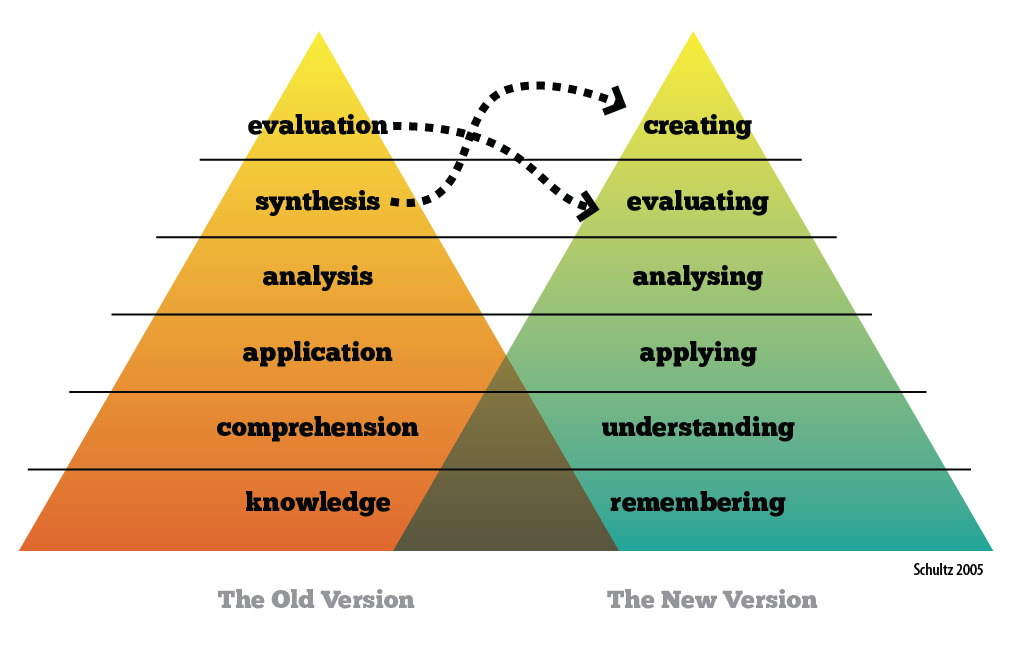
Last week we looked at Solo Taxonomy and investigated the idea of a learning trajectory, through different ‘levels’ of learning. This week we will focus more on Bloom’s taxonomy of the cognitive domain. The original taxonomy was revised by two of Bloom’s students (Anderson & Krathwohl, 2001). A potentially useful tool yet receives a lot of criticism and misinterpretation as it is often taken as a set sequence to guide instruction for learning.
‘Is evaluation really higher-order than
analysis?’
‘Isn’t understanding really a result of all the
others – an outcome of thinking rather than a type of thinking?’
‘You can’t think without context and content –
why is knowledge at the bottom when it’s the most important?’
It seems the idea of levels of thinking is problematic in many ways as thinking is not really linear. It is complex, interconnected and tied to content knowledge. Also, there are ‘levels within the levels’. Clearly, it is possible to analyse something at an in-depth, forensic or surface level or somewhere between. Yet, despite all this – Bloom is still with us. Why? Maybe because, even when we are critical of the taxonomy, it still forces us to think of learning as a journey or trajectory, rather than just remembering knowledge or a procedure.
Knowledge then Thinking, or Knowledge and Thinking?
A common criticism of inquiry-based learning is that students need to have content / knowledge to think about and inquire into. That’s absolutely true but the false choice that many argue is that we either ask learners to acquire knowledge OR we ask them to engage in inquiry. I would argue that instead, we should aim to to engage in both. Plan intentionally for the knowledge to be interwoven and infused with curiosity, habits of mind and intrinsic motivation. Pose interesting and meaningful questions and challenges that help us facilitate their thinking and learning to acquire the knowledge that is, undeniably, important for us to teach them.
Knowledge is the foundation of all learning. Yet knowledge is the residue of thinking, so we need to inspire our learners to think skillfully about what they know and question what they think they know. Teaching them to analyze, synthesize, evaluate, think critically and ask meaningful questions with and about that knowledge deserves our focus.
Inquiring into Inquiry
It appears to be a common response to think – I’ll teach them all the knowledge first, then they can apply/evaluate/create. Essentially, we can move up Bloom’s Taxonomy. In my experience, there is a couple of problems with this.
First – if your school is anything like the schools I have worked in, it is really busy and the curriculum is very crowded with content you need to cover. If you say – we’ll teach the knowledge now and we’ll get on to the evaluation / creating / analysing later, the later often never comes. Something else comes along that you need to cover and you’re back at the knowledge level again. Ever wonder why your learners seem to forget, fail to make connections and find it hard to contextualise their learning?
Second – If we consistently front-load the knowledge as
teachers, many of our learners will not engage with the content as they may not
see the relevance of the knowledge and disengage. We are not giving context to
the knowledge and surfacing relevance, connections and application. We are not fully
utilising the power of curiosity as a motivator for learning.
Curiosity is crucial to learning. Policy-makers and schools often respond by instructing teachers to engage students with ‘engaging content.’ Yet engagement and curiosity aren’t the same thing. An engaged student might be curious, but curiosity isn’t necessary for engagement. Engagement doesn’t necessarily demand an empowered thinker investigating new ideas with an open-mind and relevant questions. That’s curiosity.
Learning and Teaching
The ‘science of learning’ and the ‘craft of teaching’ are different and the relationship between teaching and learning is so much more than a straight transaction. Much of our understanding about learning is from the individual level yet many of the things we focus on about teaching a class are social. There are things like well-being, self-efficacy, peer pressure and social interaction skills to consider. That’s why teaching is so hard. If we were only learning, we’d start with the factual knowledge, move to understanding and move up Bloom’s in order. We know learning involves a certain process, but to get learners to engage with that learning process and interact with it (rather than feeling that it is something that is being done to/for them), is a completely different craft – that’s teaching.
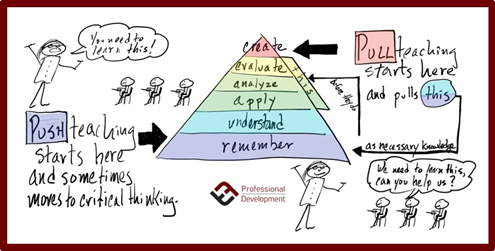
If we can start a project / domain / unit at a deeper level (eg. Create or Evaluate), we don’t start with the explicit goal of teaching lots of knowledge. That comes later. We start at a deeper level to inspire the learners to ask the right questions and to want to go back to the surface and learn the factual knowledge. The aim is to develop intrinsic motivation and curiosity.
Therefore we can open with a question, a challenge, a prompt, a provocation. Get learners confused, debating and thinking. Not because we want them to be confused, but because we want them to be so curious and motivated we can then say ‘Ok, so what do we need to know to get further into this?’ Learners start taking agency over the learning process because they have a goal in mind where they need to apply the knowledge. In essence, it offers a solution to the ‘so what?’ problem.
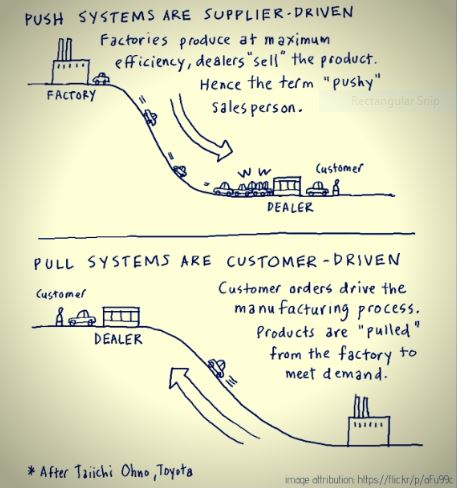
Are we pushing or pulling?
Drew Perkins of Teach Thought calls this pull teaching, as opposed to push teaching. Rather than ‘pushing’ knowledge onto the learners, as a salesman pushes products onto customers, you are ‘pulling’ learners towards that knowledge through challenge, curiosity and deliberate questioning. You then ask what are the things we need to be able to know and do to be able to create/develop this? Of course, because we have prepared properly, we already know the answer to this and know the content we are going to teach.
Planning and designing in this way involves a marked shift in the way we think and is a difficult skill to learn / unlearn. Believe me – I have tried to learn and unlearn it in different teaching contexts as the curriculum required it in different schools/systems/countries. I have mentored and supported teachers through this change process. It requires guidance and support. We won’t just be able to adapt straight away. Teachers who are new to this way of thinking need help with considering ‘How can we ensure the core knowledge is planned in and clearly on the ‘need to know’ list? Yet if we learn how to design and facilitate it well, (and that is a big ‘if’), we can start at the deep end of Bloom’s taxonomy with a question / challenge to design or create a solution to a problem or evaluate a conceptual question / statement. Of course we have already carefully planned what the core knowledge is that learners will need to meet this challenge. But we want them to come to it…
With practise and in time, students say ‘Ah. We need to know more about… to get any further ’ They come back up to the surface and you teach them the key knowledge they need to move forward. Then they can dive down deeper again. The synergy between the factual, meaning-making and application are much more fluid. We are moving around up and down Bloom’s with analysing and synthesising integrated as we go.
Starting out with
Inquiry
So to summarise, if we have planned and prepared properly (and this is where teachers need help / support), we don’t necessarily need to front-load all the knowledge. We know the surface-level knowledge will still be essential for successful learning to take place and are prepared for this. Yes, the project or inquiry will be a lot deeper and better aligned with larger goals once they have acquired the knowledge so we do have to move through all the levels for deep learning to take place. Teachers are the designers of how we can move through the levels of Bloom’s so that learners are engaged and really want to do it themselves.
We can start at ‘create’ or ‘evaluate’ in order to give context to the surface level knowledge and nurture curiosity and agency. This is a real instructional design skill. Teachers are the architects of knowledge domains / topics / units of inquiry / projects. A key element of the art of teaching is considering when & how to provide that prompt / more information. When this is done well, it is enormously powerful.
Donaldson’s Pedagogical
Principles
Professor Donaldson outlines 12 pedagogical principles in Successful Futures. I have selected a few – actually more than a few – which I would consider directly addressed by the “Pragmatic Constructivism” I have explained in this blog post.
3. employ a blend of approaches including direct instruction.
4. employ a blend of approaches including those that promote
problem-solving, creative & critical thinking.
5. set tasks and select resources that build on previous
knowledge and experience and engage interest.
6. create authentic contexts for learning.
7. employ assessment for learning principles.
8. range within and across AoLEs (Areas of Learning &
Experience)
10. encourage children to take increasing responsibility for
their own learning
11. support social and emotional development and positive
relationships
12. encourage collaboration
I hope you can see the direct connections between a pragmatic, knowledge-rich inquiry approach and the Pedagogical Principles Curriculum for Wales asks us to develop. Some might say that inquiry learning, fuelled by curiosity, agency and purpose, is ‘the icing on the cake’. Now I’m not much of a cook, but I’d say it’s more like the eggs – when mixed in properly it causes the whole cake to rise.
I’ve been involved with some great discussions on education recently through Twitter, specifically here in Wales. In Wales there are changes afoot and professional dialogue with exchange and challenge of ideas is a vital driver of that. I’ve been chatting with Heads, Deputies, Pioneers, Professors and others like myself who are teacher-consultants. Whilst all the discussions have been rich, informed and professional, a big question has been hanging over the chats and hovering in the back of my mind; Is there a right and wrong?
Let me explain. Many of those I have been discussing with are strong advocates of a Knowledge-rich curriculum, with a chief focus on Direct Instruction, Memory, Deliberate Practice (Ericsson) with a learning toward Hirsch, Christodoulou and Kirschner’s research on the failure of student-centred approaches to learning. The people I have been discussing with are experienced, knowledgeable, well-read and respected. My background and experience is in Inquiry-based and concept-based learning. The majority of my career and experience comes from international education. I have worked through the International Baccalaureate for many years and now facilitate professional development for teachers & schools through Thinking Matters, Building Learning Power and Think, Learn, Challenge here in Wales. I have witnessed the power and impact of constructivist approaches to learning first-hand. My intuition and experience tell me that knowing a lot of information is important, but it cannot and should not be our goal, or even be used as our basis for organising curriculum.
So, traditional or progressive; knowledge-based or skills-based, inquiry or direct instruction. Is one approach right and the other wrong? Is one better than the other? Are these approaches as much ‘poles apart’ as they at first appear? And what does Professor Donaldson mean when he states we should “employ a broad range of pedagogical approaches”?
THE SCIENCE OF LEARNING
Rapid developments in Cognitive Science mean we know a lot more about the brain and how it functions in recent years. We know that for us to learn, information that comes to us needs to become semantic knowledge. When you learn something new, that information comes through the senses to episodic memory. An episodic memory means the information is tied to the time and place you first encountered it. This is great, but of course our aim is to recall and retrieve the information when the situation demands it. Therefore, we need to make key facts context independent by revisiting it at different times / places. This is where all that practise comes in (Ericsson). I’m not going to go into this too deeply in this blog post, but will revisit is later. If the practise is deliberate, purposeful, repeated and spaced, we stand a good chance of creating semantic knowledge, which is stored in long term memory. Long term memory, as far as we know, has unlimited capacity.
All good so far. All this, of course, is backed up by rafts of research. But wait a minute…. Is ‘knowing a lot’ our goal? How does ‘knowledge’ differ from ‘effective understanding’? Does one naturally lead to the other, or do we need to examine the learning process a little more broadly?
SOLO TAXONOMY
The Solo (Structure of Observed Learning Outcomes) Taxonomy (Biggs, 1982) is a structured framework that helps learners and teachers think about the depth and sophistication of their learning. It is useful for informing assessment of and feedback given to learners, but also as a guide to designing tasks and questions that increase the quality of thought. Solo Taxonomy presents increasing levels of depth, or conceptual understanding, as a learner moves through the learning process or trajectory.
When considering different theories of learning, can we catagorically say that something is ‘wrong’? If you consider learning as nuanced and multi-layered, as shown in Solo or Bloom’s Taxonomy, aren’t theories such as Hattie, Piaget, Dewey, Christadoulou, Hirsch, Project Zero and Marzano, that appear opposed, just talking about different levels of learning? For example, all the research Hattie used in his meta-analysis for Visible Learning is from lab-based research, which means there are right and wrong answers, which is necessary for scientific research. It is surface-level learning and can all be located in the Uni-structural or perhaps the Multi-scructural levels of Solo. Notice this is described as quantitative – perfect for empirical data.
Yet once you get on to deeper learning – the Relational and Extended Abstract (or Transfer) levels of Solo, Visible Learning has nothing to say any more. These qualitative phases are where we start forming concepts, which are like organising principles for the knowledge. Essentially ‘how do we group and connect knowledge’? These levels are qualitative by nature and cannot really be right and wrong. At this point, many theories of learning (e.g. Hattie) become meaningless because all research used to devise their theory of teaching & learning are predicated on test of right/wrong or yes/no answers. That’s how scientific research is…
Now if we are aiming to reach this deep learning, we need to be careful. It doesn’t just happen when you know a lot. If concept or inquiry-based learning is done poorly, or we misunderstand it, we try to jump straight into the deeper levels without focusing on the surface to acquire the knowledge. This produces highly confused outcomes and feeds into the misconceptions many teachers have about inquiry or project-based learning. These misconceptions, or poor iterations, of inquiry lead to ‘free range chickens’ running about! That is, if you skip the surface and jump in, you don’t know what the children are learning or how they are organising it and they will come out with a lack of knowledge. Concept or Inquiry based learning only starts to make sense ONCE you have gone through the surface and developed your knowledge of the key content using all the deliberate practise and interleaving strategies (to be explained in a later blog posts).
Therefore, at deeper levels, things like Cultures of Thinking (Project Zero) and Concept-based learning (Erickson) become useful, yet they have little to say about surface level knowledge, memory etc. I will explain and explore these theories more closely in later blog posts.
TOWARDS A BROAD RANGE OF PEDAGOGICAL APPROACHES
It is my view that our job as teachers is not to say we’re looking for the right answer – ‘that’s right, that’s wrong’. Different research and approaches all have validity depending where you are on the learning trajectory. Our job is to work out how to align this with the outcomes we want. Ask ourselves, where am I on Solo or Bloom’s and which strategies or techniques/ frameworks will work here? These taxonomies encourage us to ask ‘what am I doing and why am I doing it?’
The political chaos we currently find ourselves in in the U.K. can teach us many things. One of the key thoughts to ponder is how easy it is in the modern world to decide on our beliefs, find evidence to support these, set up straw-man arguments in opposition and then burn them in public declaring, ‘There. I was right. Told you so.’ Some authors and speakers (and politicians?) do this very well.
If we are to move forward together and challenge polarisation, we must be prepared to question and examine our own beliefs whilst committing ourselves to learning more about approaches that we may not be familiar with or subscribe to ourselves. And not with an aim to prove that we are ‘right’ and another is ‘wrong’.



 Tyme2Think?