
Last week we looked at Solo Taxonomy and investigated the idea of a learning trajectory, through different ‘levels’ of learning. This week we will focus more on Bloom’s taxonomy of the cognitive domain. The original taxonomy was revised by two of Bloom’s students (Anderson & Krathwohl, 2001). A potentially useful tool yet receives a lot of criticism and misinterpretation as it is often taken as a set sequence to guide instruction for learning.
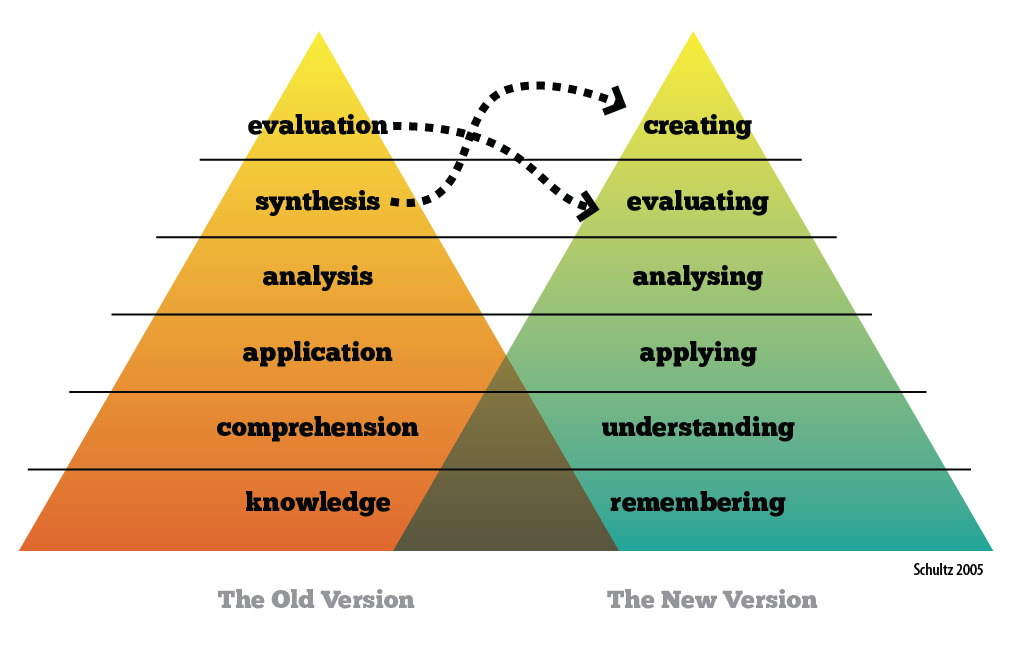
- ‘Is evaluation really higher-order than analysis?’
- ‘Isn’t understanding really a result of all the others – an outcome of thinking rather than a type of thinking?’
- ‘You can’t think without context and content – why is knowledge at the bottom when it’s the most important?’
It seems the idea of levels of thinking is problematic in many ways as thinking is not really linear. It is complex, interconnected and tied to content knowledge. Also, there are ‘levels within the levels’. Clearly, it is possible to analyse something at an in-depth, forensic or surface level or somewhere between. Yet, despite all this – Bloom is still with us. Why? Maybe because, even when we are critical of the taxonomy, it still forces us to think of learning as a journey or trajectory, rather than just remembering knowledge or a procedure.
Knowledge then Thinking, or Knowledge and Thinking?
A common criticism of inquiry-based learning is that students need to have content / knowledge to think about and inquire into. That’s absolutely true but the false choice that many argue is that we either ask learners to acquire knowledge OR we ask them to engage in inquiry. I would argue that instead, we should aim to to engage in both. Plan intentionally for the knowledge to be interwoven and infused with curiosity, habits of mind and intrinsic motivation. Pose interesting and meaningful questions and challenges that help us facilitate their thinking and learning to acquire the knowledge that is, undeniably, important for us to teach them.
Knowledge is the foundation of all learning. Yet knowledge is the residue of thinking, so we need to inspire our learners to think skillfully about what they know and question what they think they know. Teaching them to analyze, synthesize, evaluate, think critically and ask meaningful questions with and about that knowledge deserves our focus.
Inquiring into Inquiry
It appears to be a common response to think – I’ll teach them all the knowledge first, then they can apply/evaluate/create. Essentially, we can move up Bloom’s Taxonomy. In my experience, there is a couple of problems with this.
First – if your school is anything like the schools I have worked in, it is really busy and the curriculum is very crowded with content you need to cover. If you say – we’ll teach the knowledge now and we’ll get on to the evaluation / creating / analysing later, the later often never comes. Something else comes along that you need to cover and you’re back at the knowledge level again. Ever wonder why your learners seem to forget, fail to make connections and find it hard to contextualise their learning?
Second – If we consistently front-load the knowledge as teachers, many of our learners will not engage with the content as they may not see the relevance of the knowledge and disengage. We are not giving context to the knowledge and surfacing relevance, connections and application. We are not fully utilising the power of curiosity as a motivator for learning.
Curiosity is crucial to learning. Policy-makers and schools often respond by instructing teachers to engage students with ‘engaging content.’ Yet engagement and curiosity aren’t the same thing. An engaged student might be curious, but curiosity isn’t necessary for engagement. Engagement doesn’t necessarily demand an empowered thinker investigating new ideas with an open-mind and relevant questions. That’s curiosity.
Learning and Teaching
The ‘science of learning’ and the ‘craft of teaching’ are different and the relationship between teaching and learning is so much more than a straight transaction. Much of our understanding about learning is from the individual level yet many of the things we focus on about teaching a class are social. There are things like well-being, self-efficacy, peer pressure and social interaction skills to consider. That’s why teaching is so hard. If we were only learning, we’d start with the factual knowledge, move to understanding and move up Bloom’s in order. We know learning involves a certain process, but to get learners to engage with that learning process and interact with it (rather than feeling that it is something that is being done to/for them), is a completely different craft – that’s teaching.
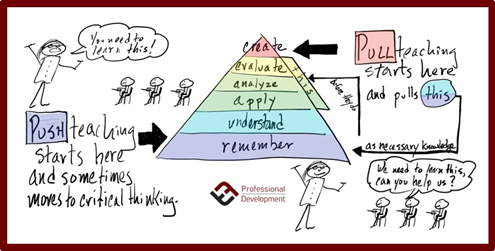
If we can start a project / domain / unit at a deeper level (eg. Create or Evaluate), we don’t start with the explicit goal of teaching lots of knowledge. That comes later. We start at a deeper level to inspire the learners to ask the right questions and to want to go back to the surface and learn the factual knowledge. The aim is to develop intrinsic motivation and curiosity.
Therefore we can open with a question, a challenge, a prompt, a provocation. Get learners confused, debating and thinking. Not because we want them to be confused, but because we want them to be so curious and motivated we can then say ‘Ok, so what do we need to know to get further into this?’ Learners start taking agency over the learning process because they have a goal in mind where they need to apply the knowledge. In essence, it offers a solution to the ‘so what?’ problem.
Are we pushing or pulling?
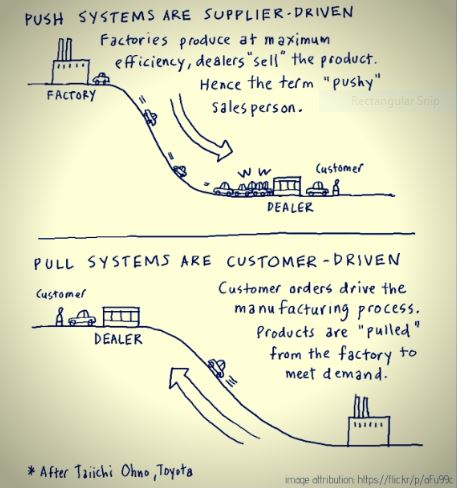
Drew Perkins of Teach Thought calls this pull teaching, as opposed to push teaching. Rather than ‘pushing’ knowledge onto the learners, as a salesman pushes products onto customers, you are ‘pulling’ learners towards that knowledge through challenge, curiosity and deliberate questioning. You then ask what are the things we need to be able to know and do to be able to create/develop this? Of course, because we have prepared properly, we already know the answer to this and know the content we are going to teach.
Planning and designing in this way involves a marked shift in the way we think and is a difficult skill to learn / unlearn. Believe me – I have tried to learn and unlearn it in different teaching contexts as the curriculum required it in different schools/systems/countries. I have mentored and supported teachers through this change process. It requires guidance and support. We won’t just be able to adapt straight away. Teachers who are new to this way of thinking need help with considering ‘How can we ensure the core knowledge is planned in and clearly on the ‘need to know’ list? Yet if we learn how to design and facilitate it well, (and that is a big ‘if’), we can start at the deep end of Bloom’s taxonomy with a question / challenge to design or create a solution to a problem or evaluate a conceptual question / statement. Of course we have already carefully planned what the core knowledge is that learners will need to meet this challenge. But we want them to come to it…
With practise and in time, students say ‘Ah. We need to know more about… to get any further ’ They come back up to the surface and you teach them the key knowledge they need to move forward. Then they can dive down deeper again. The synergy between the factual, meaning-making and application are much more fluid. We are moving around up and down Bloom’s with analysing and synthesising integrated as we go.
Starting out with Inquiry
So to summarise, if we have planned and prepared properly (and this is where teachers need help / support), we don’t necessarily need to front-load all the knowledge. We know the surface-level knowledge will still be essential for successful learning to take place and are prepared for this. Yes, the project or inquiry will be a lot deeper and better aligned with larger goals once they have acquired the knowledge so we do have to move through all the levels for deep learning to take place. Teachers are the designers of how we can move through the levels of Bloom’s so that learners are engaged and really want to do it themselves.
We can start at ‘create’ or ‘evaluate’ in order to give context to the surface level knowledge and nurture curiosity and agency. This is a real instructional design skill. Teachers are the architects of knowledge domains / topics / units of inquiry / projects. A key element of the art of teaching is considering when & how to provide that prompt / more information. When this is done well, it is enormously powerful.
Donaldson’s Pedagogical Principles
Professor Donaldson outlines 12 pedagogical principles in Successful Futures. I have selected a few – actually more than a few – which I would consider directly addressed by the “Pragmatic Constructivism” I have explained in this blog post.
3. employ a blend of approaches including direct instruction.
4. employ a blend of approaches including those that promote problem-solving, creative & critical thinking.
5. set tasks and select resources that build on previous knowledge and experience and engage interest.
6. create authentic contexts for learning.
7. employ assessment for learning principles.
8. range within and across AoLEs (Areas of Learning & Experience)
10. encourage children to take increasing responsibility for their own learning
11. support social and emotional development and positive relationships
12. encourage collaboration
I hope you can see the direct connections between a pragmatic, knowledge-rich inquiry approach and the Pedagogical Principles Curriculum for Wales asks us to develop. Some might say that inquiry learning, fuelled by curiosity, agency and purpose, is ‘the icing on the cake’. Now I’m not much of a cook, but I’d say it’s more like the eggs – when mixed in properly it causes the whole cake to rise.

 Tyme2Think?